
Mockingbird | by Walter Tevis
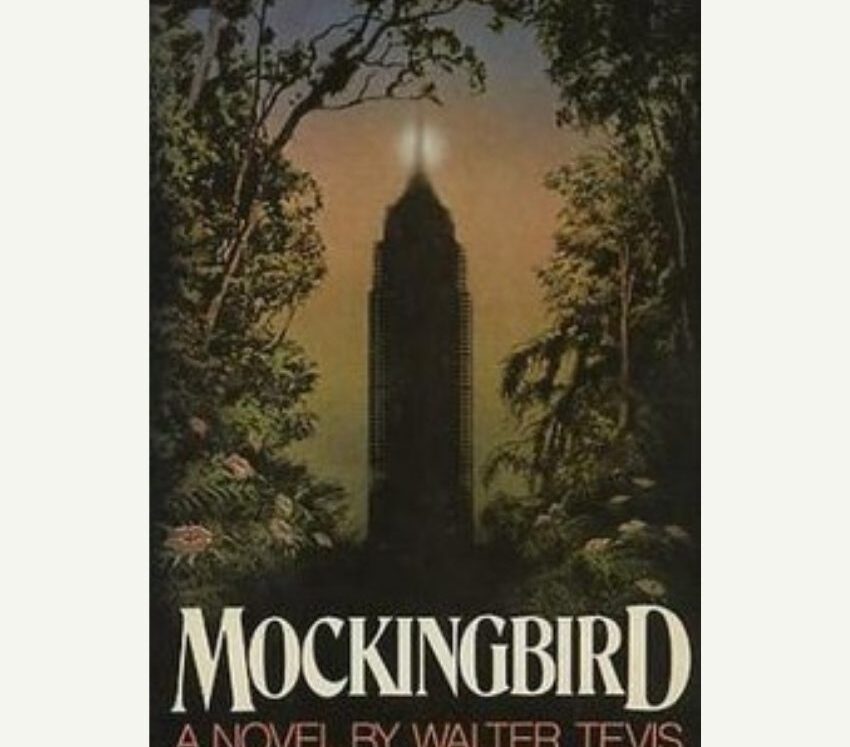
Published 1980 | Science Fiction
Mockingbird by Walter Tevis is a landmark science fiction novel that asks an unsettling question: Is there a future in which humanity can continue to exist as it is? Through a poignant tale of man, woman and machine, the book explores what it truly means to be human in a world that has chosen numbness over feeling.
What does it mean to be human? Is it the small things, the small traits like enjoying the sunlight and the feel of water on one’s skin? Or is it the bigger, more serious stuff, like the ability to think about ourselves, our space, our purpose?
These are some questions that Walter Tevis brings up in his work, Mockingbird, along with the realisation that we don’t really know what makes us human.
Set in the far, far future, in a dystopian world where humans live a drugged, soporific life that’s controlled by robots, nothing is natural anymore — not even food — and every human instinct is muted through drugs, Mockingbird is, in a way, a prediction of one of the many possible futures of mankind. Humans are not allowed to cohabit, engage in the arts, read, or engage in any entertainment except programmed television. Education has been replaced by programmed instruction, reducing humanity to vacant bodies.
Mandatory Politeness indicates that they cannot communicate with each other or make eye contact. Individualism, Inwardness, and Privacy are the rules. In this world, Spofforth is a “Make Nine” robot, the most advanced of its kind; a robot created by copying the consciousness of a human being and imprinting it onto a metal brain. Spofforth is a unique Make Nine: the flaws of his human “parent” have been erased in his manufacturing. Therefore, he is a perfect machine. But, having a human consciousness, he’s near-human in his thought processes, which means he is aware of death, and he craves nothing more than death. He’s been alive, awake 23 hours a day for centuries and he runs pretty much everything in New York.
Amidst this arrives a man (Paul) who says he can read. He’s taught himself how to. Spofforth instructs him to watch silent movies, read the subtitles, and provide transcripts. Paul meets a woman (Mary Lou) who’s rebelling against the senseless destruction of humanity and has stopped taking the ‘compulsory’ drugs. These drugs contain fertility inhibitors, which ensure that there will be no more humans in the world after a generation or so. Against the law, Paul and Mary begin to live together, learn to read and write, and piece together the history of humanity and what existed before this monochrome dullness that passes for humankind in the present.
The joy they discover in reading, their experience of music, their understanding of emotions, friendship, and kinship give the reader a jolt because one realises that we’re taking these things for granted. How often do we appreciate these beautiful, joyous aspects of being human? Paul is utterly enamoured with the process of reading and steals books wherever he can find them. (It’s illegal to read, no more books are created and the ones that exist have been stored for destruction).
The book dwells deeply on existential questions, free will, and emotions. It roots us in our present – are we slowly, inexorably moving towards such a future due to our obsession with Individualism, and inability to coexist in healthy communities? Will we be in a world without children soon, as having children is getting replaced by other pursuits for more and more people? Are we denying our basic human reactions by labelling them as illnesses, and creating a generation of soporific people who cannot get anxious, cannot get upset, who never feel anything?
What are we doing to create our future?
Slow, intense and engrossing, this book was published in 1980, and I cannot think of a better time to read this than now.
